Showing posts with label Aircrafts. Show all posts


The realm of aerial combat has entered a new era defined not by sheer speed or agility alone, but by a trinity of revolutionary capabilities: Stealth, Sensor Fusion, and Networked Warfare. This is the domain of the fifth-generation fighter jet—a flying supercomputer designed to see first, strike first, and survive against overwhelming odds. Today, only a handful of nations operate these technological marvels. Here is a look at the top five, the apex predators ruling the modern skies.


What Makes a Jet "Fifth-Generation"?
Before we count them down, let's define the key traits:


  • Very Low Observable (VLO) Stealth: Radically reduced radar, infrared, and visual signatures.

  • Advanced Avionics & Sensor Fusion: Data from radar, EW systems, and off-board sources (like satellites or other jets) is blended into a single, intuitive "God's-eye-view" for the pilot.

  • Supercruise: The ability to sustain supersonic flight without fuel-guzzling afterburners.

  • High Agility: While often less emphasized than in 4th-gen jets, they remain exceptionally maneuverable.

  • Multirole Capability: Excel at both air-to-air dominance and precision air-to-ground strikes.


5. Shenyang FC-31 / J-35 (China)
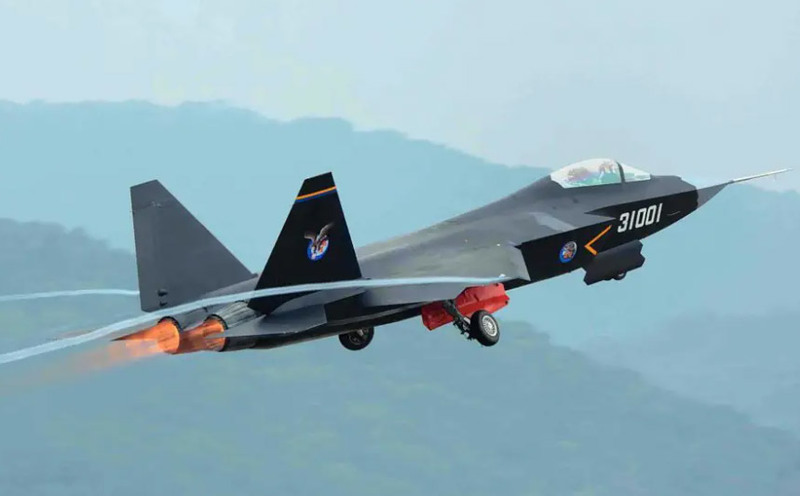
 

The Emerging Dark Horse

Currently a developmental aircraft and the basis for China's next-generation carrier-based fighter (J-35), the FC-31 represents China's second fifth-gen program and a potential future export competitor to the F-35.


  • Design: A mid-sized, twin-engine design that bears a superficial resemblance to the F-35, suggesting a multirole focus balancing air combat and strike missions.


  • Potential: It aims to offer a more affordable and exportable fifth-gen option while serving as a crucial component of China's future carrier air wings. Its development indicates China's commitment to building a full ecosystem of stealth combat aircraft.


  • Unknowns: Its sensor capabilities, true stealth characteristics, and performance data remain largely speculative as it is not yet in operational service.


Verdict: A wildcard with significant potential to reshape the global stealth fighter landscape in the coming decade, both in the Pacific and on the export market.


4. Sukhoi Su-57 "Felon" (Russia)

 
The Agile Supercruiser

Russia's entry into the fifth-gen club emphasizes a different blend of characteristics, prioritizing super-maneuverability and powerful weaponry alongside reduced observability.


  • Performance & Armament: Equipped with thrust-vectoring engines, the Su-57 is likely the most agile aircraft on this list. It is designed to carry a huge payload, including uniquely large internal weapons bays for very long-range or even hypersonic missiles.


  • Stealth: Considered the weakest in "pure stealth" among this group. Its design includes some stealth features but compromises with features like external hull joints and a less integrated engine design.


  • Sensors: Boasts a sophisticated suite, including N036 Byka AESA radar with L-band arrays on the wing leading edges, designed to help detect stealth aircraft.


  • Limitation: Its "stealth-first" compromise, low production numbers, and questions about its advanced sensor fusion maturity place it in this position.


Verdict: A potent and dangerous "4.5+ generation++" fighter that brings unique Russian strengths in kinematics and heavy weaponry to the fifth-gen conversation.


3. Chengdu J-20 "Mighty Dragon" (China)

 
The Long-Range Interceptor

China's answer to fifth-generation air power, the J-20, presents a unique and formidable design philosophy focused on the vast Asia-Pacific theater.


  • Design & Role: Its large, elongated airframe, canards, and focus on powerful AESA radar suggest a primary role as a long-range "air superiority interceptor." It is built to target high-value support aircraft (like tankers and AWACS) and engage fighters from great distances.


  • Stealth: Estimates suggest it has potent frontal-aspect stealth, though its rear-quarter and engine details may be less optimized. Its canards present a stealth challenge.


  • Weapons: Features large internal bays for long-range, radar-guided PL-15 missiles, giving it a significant "first-look, first-shot" advantage.


  • Limitation: Until recently, it relied on older Russian-derived engines, limiting supercruise ability. New WS-15 engines may be changing this. Its true sensor fusion capabilities remain less known.


Verdict: A specialized, high-threat system designed to challenge access in key regions, representing China's leap into advanced aviation.


2. Lockheed Martin F-35 Lightning II (United States)
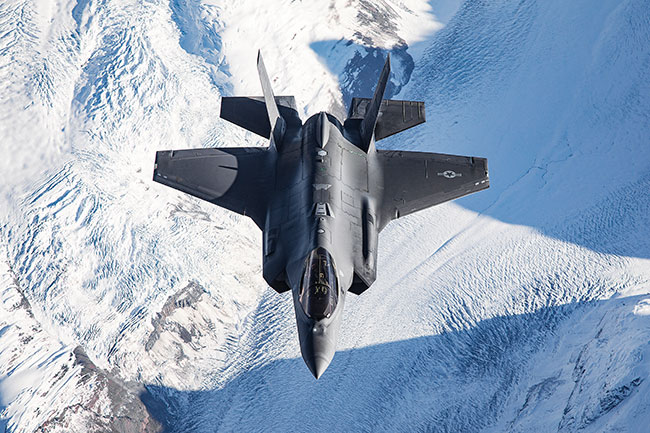
 
The Digital Quarterback of the Battlespace

If the F-22 is the elite duelist, the F-35 is the ultimate team player and information hub. Built in three variants (Conventional F-35A, STOVL F-35B, Carrier-based F-35C), it is the most widely produced and exported fifth-gen fighter.


  • Sensor Fusion: This is the F-35's crown jewel. Its AN/APG-81 AESA radar, Electro-Optical Targeting System (EOTS), and Distributed Aperture System (DAS) create an unparalleled 360-degree awareness that can track targets and share data seamlessly with allied forces.


  • Stealth: While optimized for a balance of stealth and payload, it remains exceptionally stealthy, particularly from frontal aspects.


  • Network Centric: The F-35 is designed to be a "flying server," gathering and disseminating targeting data for ships, other aircraft, and ground troops without ever firing a shot itself.


  • Limitation: It lacks the raw speed, altitude, and agility of the F-22, making it less focused on deep penetration air superiority.


Verdict: The F-35 is the linchpin of modern networked warfare, making entire allied forces more lethal.


1. Lockheed Martin F-22 Raptor (United States)
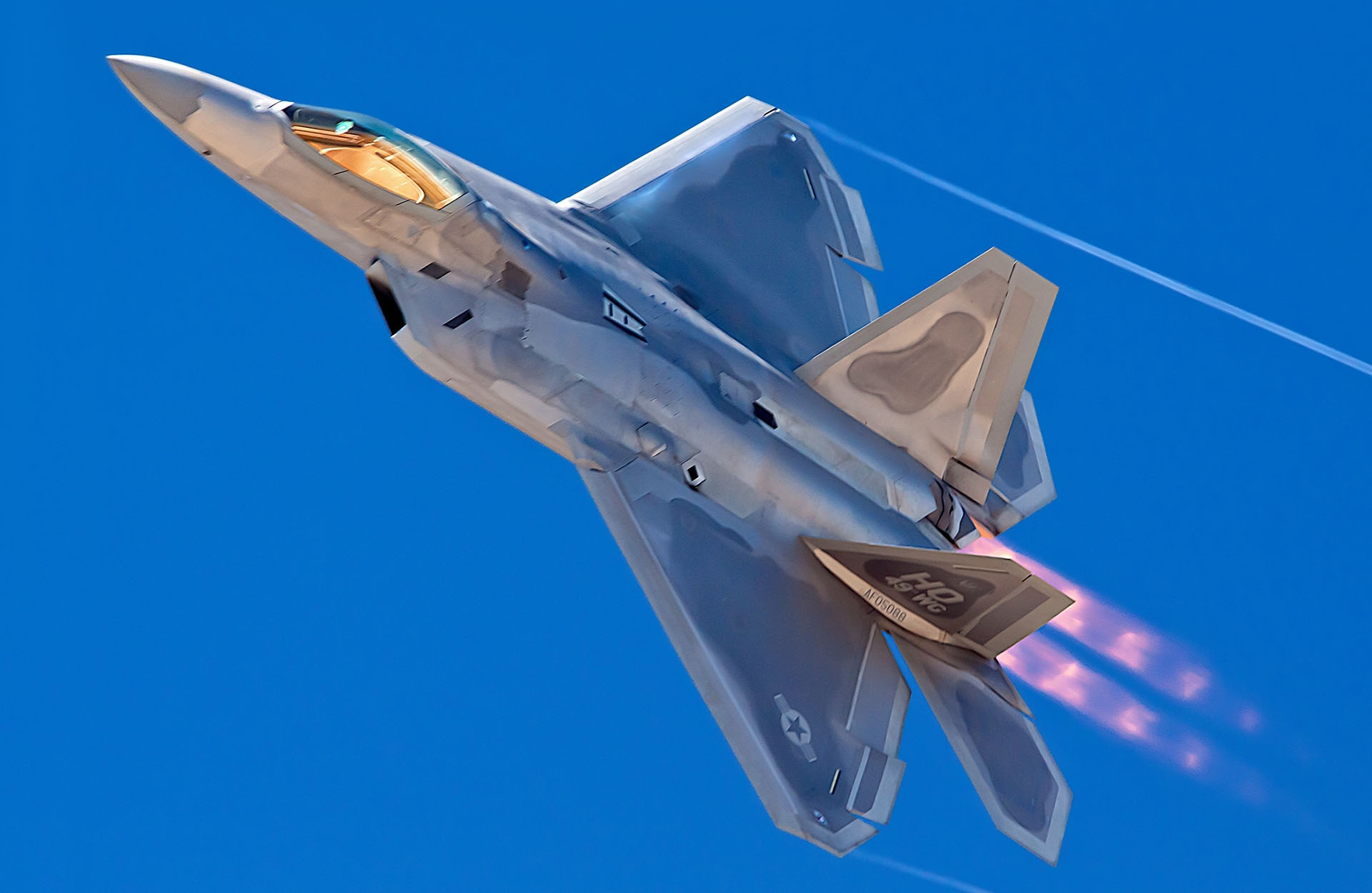
 
The Undisputed Air Dominance King

The F-22 was the first operational fifth-gen fighter and remains the benchmark for pure aerial combat. Designed to achieve and crush enemy control of the skies, its combination of attributes is still unmatched.


  • Stealth: Its radar cross-section is often compared to that of a marble. Its design, materials, and internal weapon bays make it the stealthiest air-to-air fighter ever built.


  • Performance: With supercruise over Mach 1.8 and thrust-vectoring engines, it possesses breathtaking kinematic performance—it can outrun and outmaneuver any potential adversary.


  • Sensor Suite: The AN/APG-77 AESA radar and sophisticated sensor fusion give Raptor pilots unparalleled situational awareness.


  • Limitation: Its production line closed in 2011, limiting numbers and making upgrades costly. It also has limited ground-attack focus compared to others on this list.


Verdict: In a within-visual-range (WVR) or beyond-visual-range (BVR) dogfight, the F-22 remains the aircraft to beat.


Summary Comparison Table

AircraftCountryPrimary RoleTop SpeedStealth Level
F-35 Lightning IIUSAMultiroleMach 1.6High
F-22 RaptorUSAAir SuperiorityMach 2.25Extreme
Chengdu J-20ChinaAir SuperiorityMach 2.0+High
Sukhoi Su-57RussiaMultiroleMach 2.0Medium
Shenyang J-35AChinaMultiroleMach 1.8+High

The Future of the Pecking Order

 
The gap between the fourth and fifth generations is no longer just about the airframe—it's about the software. As we look toward the 2030s, "Sixth-Generation" programs like the U.S. NGAD (Next Generation Air Dominance) are already in development, promising even greater integration with AI and unmanned "loyal wingman" drones. For now, however, these five titans remain the gold standard of aerial power.


This list is dynamic. The upcoming American Next Generation Air Dominance (NGAD) program, Europe's Future Combat Air System (FCAS), and the UK's Tempest promise a sixth generation of even more advanced, potentially optionally manned systems. But for now, these five represent the cutting edge of manned fighter technology—a combination of stealth, silicon, and strategy that defines air power in the 21st century.


Many of the fastest aircraft's are no longer in use, but they can still be found among the legends of aviation. Design and sophistication of these aircraft left a mark on future models and even the development of new airline technologies that have shaped the 21st century sky.

Flying fighter jets was always a call for selected, and from the end of World War II technology made this aircraft into a "job on the edge of science fiction."


10. Su-27 Flanker
Maximum supersonic speed of Mach 2.35 (1,550 mph, or 2,500 km/h)
First flight in May 1977

9. F-111 Aardvark
Maximum speed of Mach 2.5 (1,650 mph, or 2,655 km/h)

8. F-15 Eagle
Maximum speed greater than Mach 2.5 (1,650 mph, or 2,655 km/h)
First flew in July 1972


7. MiG-31 Foxhound
Maximum speed of Mach 2.83 (1,860 mph, or 3,000 km/h)
First flight in September 1975


6. XB-70 Valkyrie
Maximum speed Mach 3.02 (2,000 mph, or 3,219 km/h)
Range: 6900 km
First flight: 21 September 1964

5. Bell X-2 "Starbuster"
Maximum speed Mach 3.2 (2,094 mph, or 3,370 km/h)
First flight: 18 September 1955

4. Mikoyan-Gurevich MiG-25 Foxbat
Maximum speed Mach 3.2 (2,190 mph, or 3,524 km/h)
Range: 2573 km
First flight: March 6, 1964

3. Lockheed YF-12
Maximum speed of Mach 3.2 (2,070 mph, or 3,330 km/h)
First flight: 1963 


2. SR-71 Blackbird
Maximum speed  Mach 3.3 (more than 2,200 mph, or 3,540 km/h)
Range: 5925 km
First flight: 22 December 1964

1. X-15
Maximum speed Mach 6.72, which is 6.72 times the speed of sound, or 4,520 mph (7,274 km/h)
First flight: 8 June 1959         
If we are to believe some of the greatest minds of our era, it is probably good that artificial intelligence is not yet at that level that we should be worried that would one day these weapons might turn against us. But the future of warfare definitely lies in the weapons that do not require directly the presence of military personnel on the battlefield. In recent years, military forces have invested heavily in the so-called drones, unmanned aircraft that were initially used for the purpose of studying the hostile terrain, and lately more as a craft with the possibility of attacks on military targets. Some of them are still in the testing phase, while others are already in use for years and sow fear battlefields across the globe. Today we bring you the seven deadly drones that clearly indicate the direction of the future of warfare.

Northrop Grumman RQ-4 Global Hawk

Primarily designed with the aim of monitoring and collecting information in order to replace the famous Lockheed U-2 spy plane, the Global Hawk eventually gets the versions with heavy weapons that can inflict heavy losses to the opponent. The price of each unit is more than $ 100 million, but as it's not managed by pilot, can in the air spend more than 30 hours, during which cover more than 100,000 square kilometers of terrain. Equipped with the most advanced equipment for monitoring, and considering the mission, can carry up to 1,360 kilograms of weapons.

CH-4 (Cai Hong-4)

Chinese spacecraft developed in response to the US MQ-1 Predator unmanned aircraft. The main purpose the reconnaissance, surveillance, information gathering, targeting and attack on military targets on land and water. In the air may spend as much as 38 hours with a maximum range of 3,500 kilometers. The maximum height of flight is 8000 meters and can carry 345 kilograms of weapons, which is quite a burden with regard to the length of the drone only 9 meters. CH-4 has the ability to launch missiles from a height of 5000 meters, with the possibility of errors up to 1.5 meters. One copy is in the composition of the Iraqi army, and is used in the fight against global terrorism. 

MQ-9 Reaper (aka Predator B)

MQ-9 Reaper unmanned aerial vehicle, begin as an ordinary type of Predator unmanned aerial vehicle, with the subsequent improvements probably the most lethal aircraft currently in active military service. Upgraded turbo engine gives it nearly nine times more power than the Predator aircraft type, which allows up to 36 hours of continuous flight of more than 1,300 kilograms of weapons, as many as fifteen times more compared to the Predator aircraft type. It has the ability to launch laser-guided bombs and Hellfire missiles with incredible precision to land, but also military targets in the air. The maximum flight altitude of over 15 kilometers.  

General Atomics Avenger (Predator C)

Developed based on MQ-9 Reaper, Avenger launches a jet engine with exhaust-shaped, in order to reduce heat and radar trace. It has been developed on the basis of "stealth" technology, and storage of weapons found within the craft. With a top speed of flight of 740 km / h, operating height of more than 18 kilometers, and the possibility of staying in the air for more than 20 hours, the Avenger can sneak up on an opponent and inflict enormous damage without even being noticed. Armament Avenger similarly as with the Reaper drones, and internal storage can store about 1,400 kilograms of weapons. Although the first flight took place back in 2009, the Avenger is not yet in active military service. 

BAE Systems “Taranis”

Unmanned future aerial vehicle developed by British company BAE Systems for the British Air Force. Named after the Celtic god of thunder, Taranis, the unmanned aircraft had its first test flight in 2013, until the end of the year they plan to final testing. Although the data on this drone for now quite thin, it is known that it will fly at a speed greater than 1100 km / h and will be used for reconnaissance missions as well as missions of marking targets, and will have the option of attacking ground targets, but also the possibility air combat. As Avenger, using "stealth" technology, and can seamlessly approach to the target and use all of its hidden arsenal.

Boenig Phantom Ray

Boeing project that instills fear into anime Phantom Ray unmanned aerial vehicle that is designed to operate autonomously (without operator assistance), and determines the course of the mission itself. Yes, we are one step closer to machines that think for themselves, and when we consider that these unmanned aircraft can carry more than two tons of weapons, the same to us instantly create a lump in my throat. With the "stealth" technology, the speed of flight of nearly 1000 km / h and a range greater than 2,400 kilometers, just waiting for when a copy can run out of control. The good thing is that this aircraft is still in the testing phase.

Northrop Grumman X-47B

Northrop Grumman response on Boeing Phantom Ray unmanned aircraft, but unlike it, this aircraft is in the active military service of the United States Navy. X-47B's first unmanned aircraft that flew and landed on an aircraft carrier, and it is the first unmanned aerial vehicle which was successfully carried out the maneuver refueling in the air. Unlike the Phantom Ray unmanned airborne vehicles, X47-B is not completely autonomous, but as she used "stealth" technology and can carry more than two tons of weapons. In 2015, the program of development of the aircraft was stopped, and the two produced copies for now remain in active military service. 
Killer combat aircraft's are still the coolest weapons of any battlefields.

Su-35 Flanker E

The most modern version of the best Russian aircraft of all time brought an even greater range, lower radar reflection, more powerful engines, a new, cutting-edge, digital avionics and watch now this - a radar that looks back! Given that the price between 45 and 65 million dollars, which was considerably less in in comparisons with similar Western aircraft, expected to successful sales in foreign markets. In addition to Russia's interest have shown, India, Venezuela, China and Indonesia.

Country of origin: Russia, year of entry into service: 2010, Weight with max. weapons: 25,300 kg, Maximum speed: Mach 2.25.


F-16 Fighting Falcon


The most popular aircraft of today's is Viper, to over 20 customers around the world there are over 4,500 copies. Originally designed as a light-attack aircraft for attacks on ground targets per day, F-16 is due to its characteristics quickly turned into a multipurpose aircraft that at night destroys their targets by large selection of available arsenal. There is no war in which it was not used successfully.

Country of origin: USA, year of entry into service: 1978, Weight with max. weapons: 19.020 kg, Top speed: Mach 2.5.


F-15E Strike Eagle

Attack version of the legendary fighter proved to be equally successful in attacks on ground targets as well as attacks on other aircraft. He hunted SCUD's in Iraq, bombed Taliban strongholds in Afghanistan, attacked the airport in Serbia and destroy tanks in Libya. Selection of the arsenal and the quantity it can take is amazing, the Strike Eagle today, rightly, consider as the most perfect killing machine.

Country of origin: USA, year of entry into service: 1988, Weight with max. weapons: 36.700 kg, Top speed: 2.50 Mach.


F-35 Lightning II

The latest project of the US Air Force is Lightning, which should replace the F-16s. Specificity is the ability of aircraft taking off and landing like a helicopter, which allows him to land and take off from anywhere. It will be manufactured in three versions - a standard version, version for short launches and landings and naval variant for use on aircraft carriers. It is planned to produce 2,500 copies at a cost of over $ 125 million per copy!!!

Country of origin: USA, year of entry into service: 2016, Weight with max. weapons: 22,470 kg, Maximum speed: Mach 1.60.


JAS 39 Gripen

Together with IKEA-TV, Absolut Vodka, hockey and blondes, Gripen is the most famous Swedish export product. Extremely capable aircraft did not experience greater export success because his competition is F-16, which has a lot stronger logistics, and his government pressure the customers. In service in Sweden, South Africa, Czech Republic and Hungary.

Country of origin: Sweden, year of entry into service: 1996, Weight with max. weapons: 14,000 kg, Maximum speed: Mach 2.


Eurofighter Typhoon

A joint project of the United Kingdom, Germany and Italy, had dragged over the years that it was thought that the whole thing will collapse. However, after much delay the first aircraft in 2003 finally began to enter the weapons. In the cockpit Typhoon are the most modern systems, such as voice control, but all of this is resulting in a price of $ 120 million per copy. Quite apart from the three mentioned countries have procured it, and Austria, Spain and Saudi Arabia.

Country of origin: United Kingdom, Germany and Italy, year of entry into service: 2003, Weight with max. weapons: 23,500 kg, Maximum speed: 2.00 Mach.


MiG-35 Fulcrum F

The most modern version of the legendary MiG-29 fighter turns this into an extremely capable multi-purpose aircraft. Special attention is given its most advanced AESA radar (Active Electronically Scanned Array) and adding more powerful engines improved range and mobility.

Country of origin: Russia, year of entry into service: 2007, Weight with max. weapons: 29,700 kg, Maximum speed: Mach 2.25.


F-22 Raptor

Definitely the most modern aircraft of today is intended primarily hunting opponent aircraft's. The weapons carried in special containers and is less visible on the radar of seagull, and all avionics and electronics installed in the aircraft are the pinnacle of technology. Due to the exorbitant price of $ 150 million per copy, procurement of only 187 aircraft and despite the interest of Israel, the export is not allowed because of the confidentiality of certain parts of the aircraft!

Country of origin: USA, year of entry into service: 2005, Weight with max. weapons: 36,228 kg, Maximum speed: Mach 1.90.


F/A-18E/F Super Hornet

The latest version of the Hornet, called the Super Hornet, from use is pushed out legendary Tomcat. Although, as efficiency is concerned, does not offer more than Tomcat, the Super Hornet is streamlined and use of only one type on aircraft carriers reduce costs. This veteran of the wars in Afghanistan, Iraq and Libya has proven to be very successful and effective.

Country of origin: USA, year of entry into service: 1999, Weight with max. weapons: 29,937 kg, Maximum speed: Mach 1.80.


Dassault Rafale

The French simply have to have their own product, even out in the early stages of the projects Eurofighter and Rafale, delta wing aircraft inherited Mirage 2000.  In the end, produced him before Birtanaca and at a lower cost, and some will say that the Rafale is even better than the Eurofighter. If anything, it looks a lot nicer.

Country of origin: France, year of entry into service: 2000, Weight with max. weapons: 324,500 kg, Top speed: 2.00 Mach.


NOTE: Russian Sukhoi T-50 has not yet entered into service and therefore is not on this list. 

Content Ad

Recent Comments

Premium Blogspot Templates
Copyright © 2012 Men's Corner
